

There are two ways to make a face.
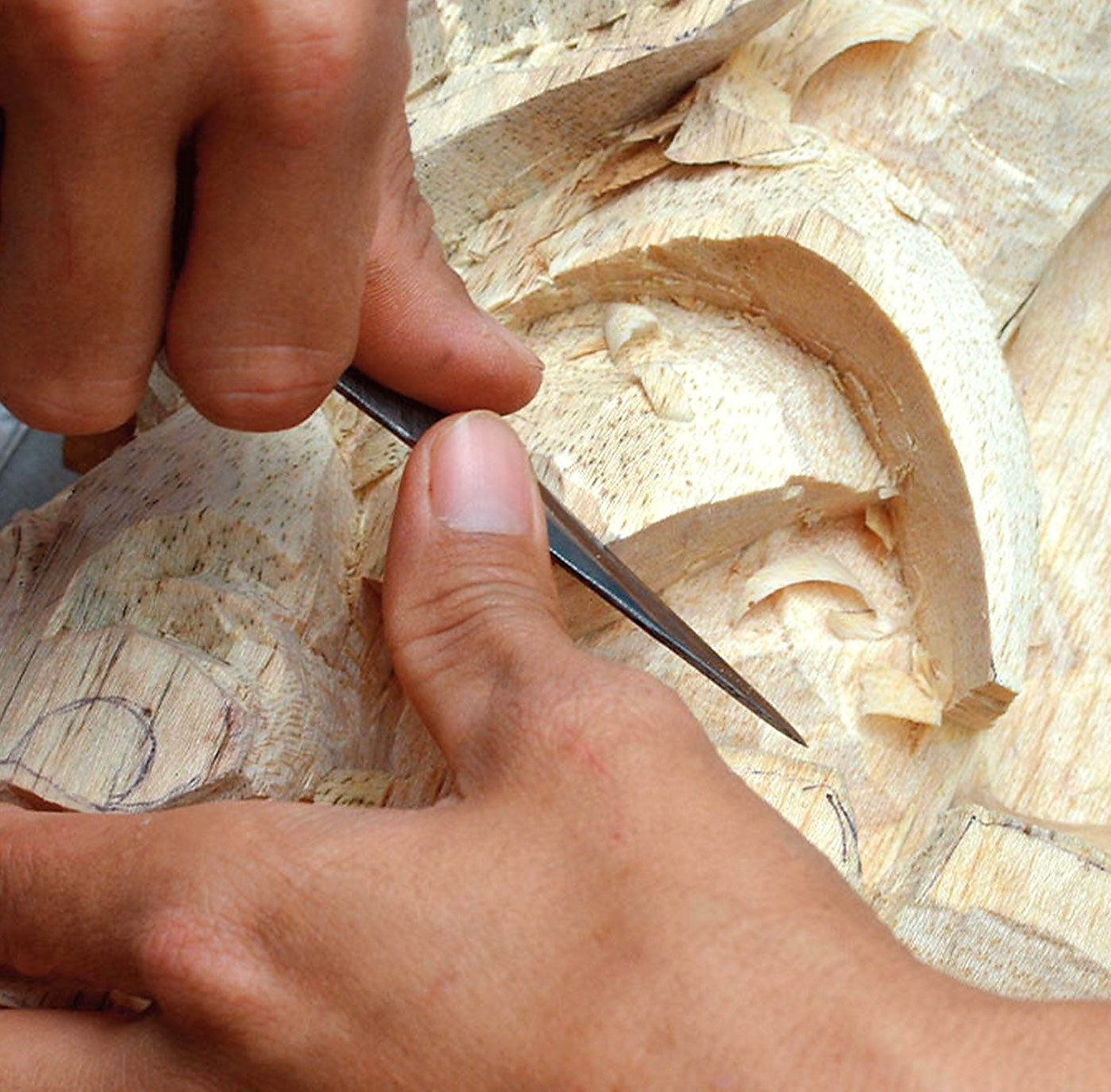
The first is made by adding: a little clay, a layer of paper, another layer, and another, until a clay sculpture becomes a light shell that someone can wear on their head. The second is made by taking away: you start with a block of wood and remove everything that is not the face.
Both ways live in Costa Rica. And to understand them, you have to visit three places.
Barva: When Clay Becomes a Shell

In Barva, in the province of Heredia, the craft begins with patience. The clay is kneaded for about four hours to work out the air bubbles, the face is sculpted by hand, and it is left to rest for a week. Once dry, the layers begin: strips of newspaper or cement-sack paper glued with a paste of water and flour. It takes around fifteen. Then the clay is removed, the surface is smoothed and painted, and a face that did not exist a moment ago appears.
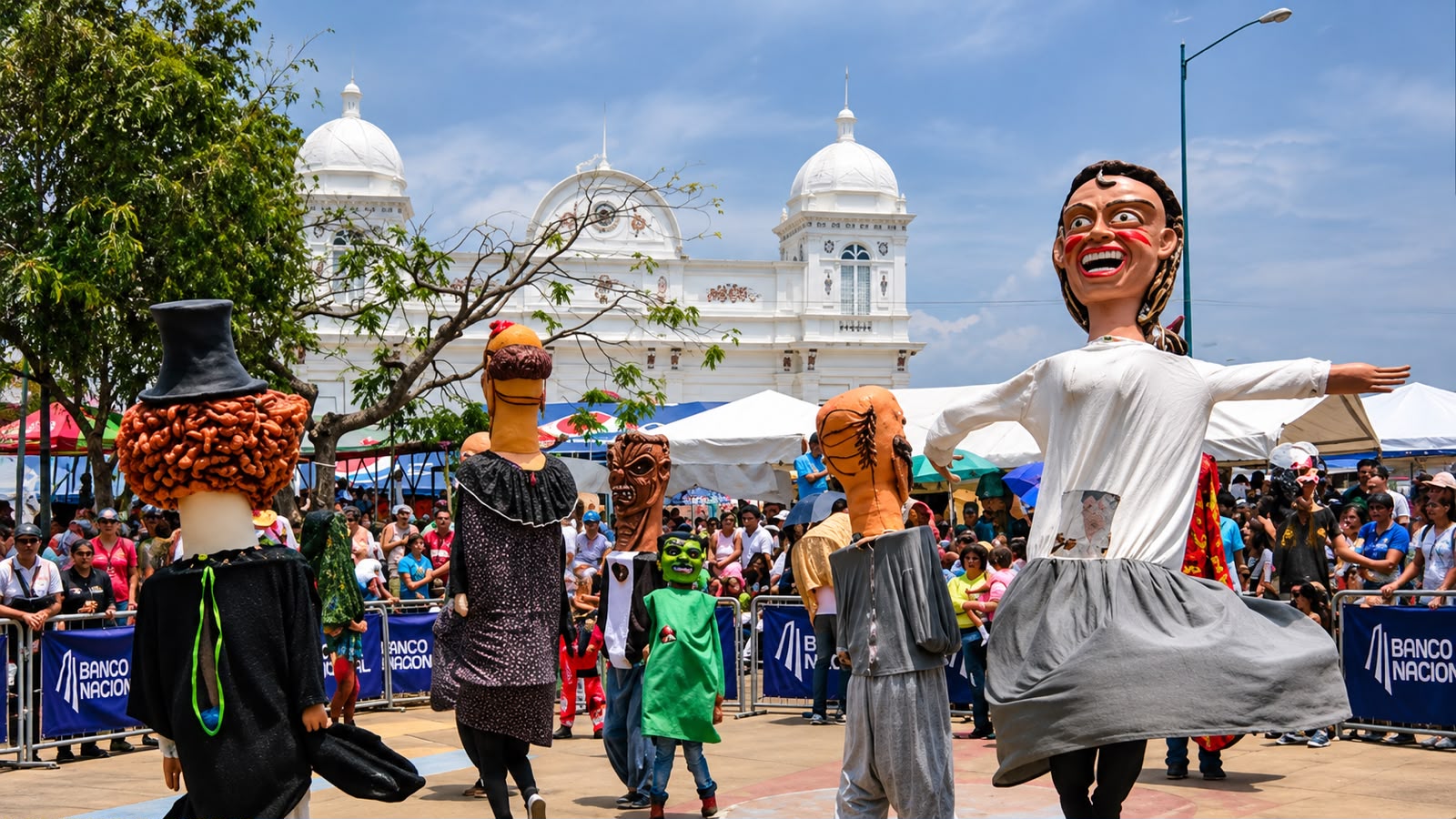
The technique has a story behind it. According to tradition, Rafael “Lito” Valerín, the craftsman from Cartago credited with the first Giganta (the towering “Giant Woman” of the mascaradas), found a mask head of Spanish origin in a corner of the church and took it as a message from the Virgin. With it and a wooden frame, he built the first Giganta, and he blended his way of working with paper together with the mantudos, people who covered themselves in colorful blankets with holes for the eyes.
From that craft, Carlos Salas, the village’s first mascarero (mask maker), brought the tradition to Barva. Today, one Barva workshop reportedly keeps two of his original pieces from the 1920s. And the craft is no longer only for older men: a woman from Barva made her first mask at age 11 and was the first in her town to wear the Giganta, and young artisans now teach children. Every year, in the last week of March, the town celebrates its National Mascarada Fair.
That is its significance: in Barva the craft stopped being a curiosity and became a way of life, passed from generation to generation.
Santa Ana: The Music That Made the Giants Dance

A mascarada without music is just a figure standing still. In Santa Ana, in the province of San José, someone understood that more than a century ago.
Around 1910, the Municipal Band was led by maestro Manuel Jiménez Sosa, and later by his brother Crisanto, and the Jiménez family kept the cimarrona alive in the canton. The cimarrona is the popular brass band that accompanies festivals: groups of three to five musicians with trumpet, saxophone, snare drum, bass drum and cymbals. One of them had the idea of making the mascaradas built by the neighbors dance to the rhythm of sones, jotas, contradanzas and pasillos. That union between cimarrona and mascarada has lasted to this day, and the group now calls itself “La Centenaria” (“The Centennial”).
The tradition keeps renewing itself: the Mascarada Santana, led by mascarero Julio Solís, has three Gigantas, one of them unveiled at the 2022 patron saint festivities.
Santa Ana provides the music.
San Antonio de Escazú: The Frame That Gave Them Height

If Santa Ana set the rhythm, San Antonio de Escazú, also in the province of San José, gave them their stature.
The giants are not masks: they are figures mounted on a wooden or wire frame, with the head on top and the body covered by a cloth. The cabezudos (“big heads”), on the other hand, fit directly over the wearer’s head. There, Pedro Arias, considered by researchers to be the most important mascarero of Escazú, created a frame that gave the figures greater height. The idea did not stay with one man: one of his descendants, Gerardo Montoya Arias, continues the workshop today.
That is why the Giganta is so imposing. As the story goes, she was born as a mockery of the wealthy ladies of the colonial era, and the earliest mascaradas portrayed figures of authority in colorful and humiliating ways: the Spanish lady, the devil, death, the policeman and the peasant. A people laughed at power by making it out of paper and lifting it onto a frame.
Rey Curré: The Face That Is Carved

Now we change region, material and way of thinking. In Rey Curré, in the southern Pacific region, no one adds layers. You start with a block of balsa or cedar wood and carve it with a knife.
According to one artisan, the original mask carried no color: only the horns and protruding teeth stood out. Today, nature motifs are common. The masks are used in the Juego de los Diablitos (the Game of the Little Devils), in which the men of the community, dressed in burlap sacks, face a bull that represents the Spanish invader. According to one report, on the first day the devils may not wear colorful masks, as a sign of respect.
What is most striking about Rey Curré is that it is the youngest tradition on this journey. According to one artisan, a family from Boruca moved there in the 1950s, and other families followed. A group of neighbors who remembered traveling to Boruca as children for the game, led by don Lucas Rojas, decided to celebrate it in their own community starting in 1979. Today it is held on the first weekend of February, a month after Boruca’s. Boruca is regarded as the cradle of mask carving in the country, but Rey Curré shows something equally valuable: that a community can choose to recreate its own tradition.
The game was declared Intangible Cultural Heritage in 2017. And its significance has a delicate side as well: according to one article, outside pressure to turn it into a tourist attraction has been felt most strongly in Rey Curré, and that has gradually relaxed some traditional rules. It is a living tradition, and like every living tradition, it is best looked after by looking on with respect.
What Clay and Balsa Share

One is made by adding and the other by taking away. One goes out dancing with a cimarrona through the streets of the Central Valley, and the other faces a bull in the mountains of the south. But in both, someone decides, with their own hands, that a face deserves to exist.
And those hands are still at work.