

Two Paths of the Mask in Costa Rica
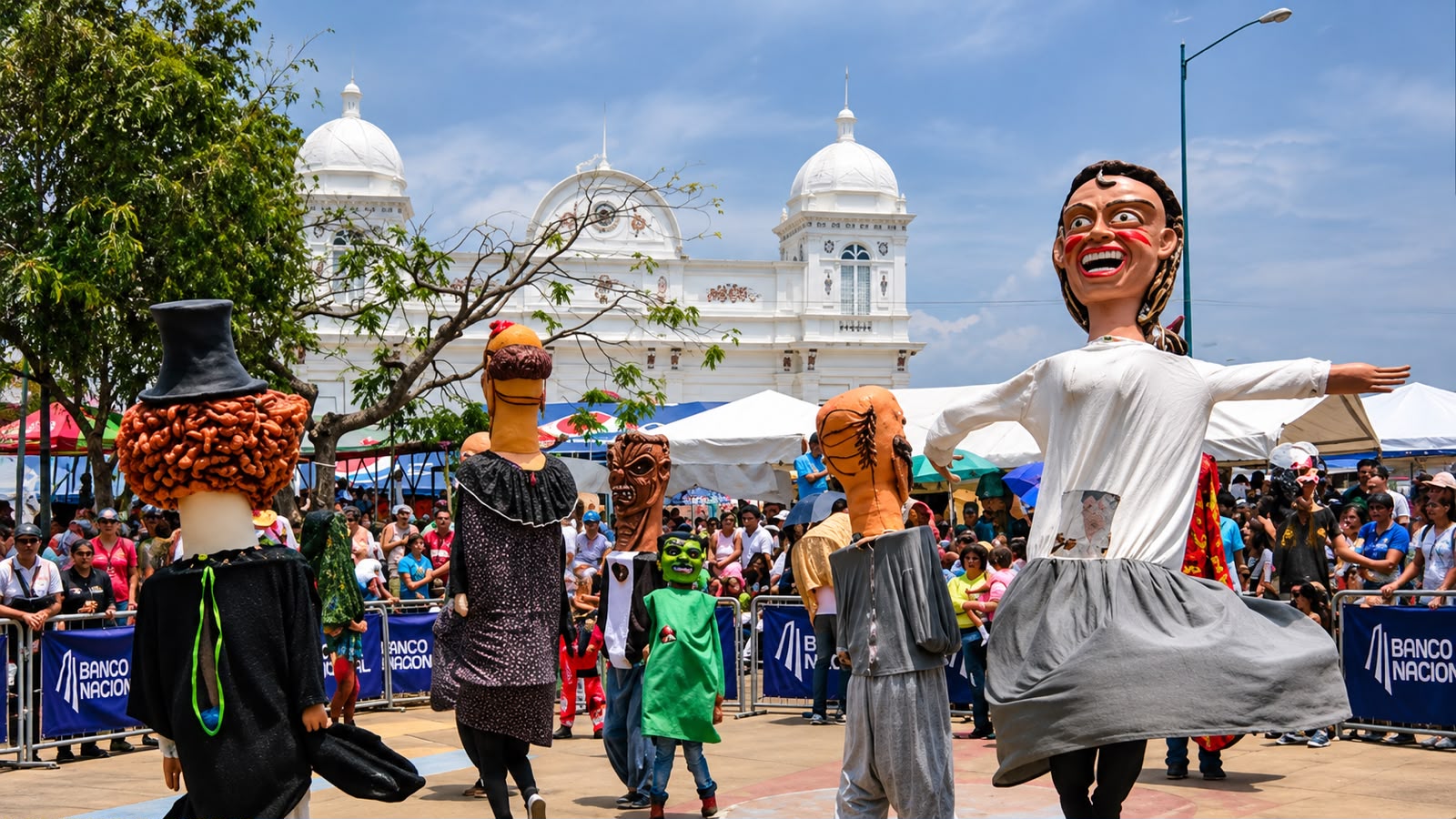
Picture yourself walking through a Costa Rican town when, suddenly, a cimarrona starts to play, the popular band of trumpets, trombones and percussion that accompanies nearly every town festival in the country.
Children come running. A clown with an enormous face chases after them. And in the distance, a Giganta, a towering giantess named for her extraordinary height, sways from side to side as if the street belonged to her.
A New Date to Defend Something Very Old
On October 31, 1996, a cultural committee and several artisans from Aserrí, in the province of San José, organized a parade of mascaradas. It was the night when many people dressed up as characters from abroad. A year later, the government officially declared the Day of the Mascarada, with the aim of strengthening national identity. And it worked: in 2022, the mascarada was declared a national symbol.
So what was so ancient that it needed protecting?

An Earthquake, a Workshop and a Town That Danced Again
The story goes back to colonial Cartago, to festivals where traditional characters appeared. The Spanish brought their giants and big-headed figures (gigantes and cabezudos), and here they blended with Indigenous influences. From the very beginning, the mascarada was a fusion.
And it came close to disappearing. The 1910 Cartago earthquake wiped out the mascaradas. But in 1912, Jesús Valerín organized a carnival using the masks he had managed to save. Consider what that means: a city in ruins, in mourning and in fear, and someone decides to bring the giants back into the streets.
Molds That Passed From Hand to Hand
From then on, the craft was handed down like a family secret.
Valerín’s molds reached the Freer brothers, who brought the mascaradas to San José for the first time. In Barva, in the province of Heredia, Carlos Salas was the first mascarero (mask maker), and today the town hosts its own National Mascarada Fair every year during the last week of March. In Escazú, in the province of San José, Pedro Arias, known as the master of the mascareros, created a frame that gave the figures greater height, and the craft continued with his children and grandchildren.
Each town received a mold and made it its own.

In the South Pacific, a Mask That Doesn’t Make You Laugh: It Makes You Remember
Now let’s travel to another corner of the country, where the mask serves a different purpose.
In Boruca and Rey Curré, Indigenous communities of the South Pacific, people dance the Juego de los Diablitos (the Game of the Little Devils). It is a battle: the bull represents the Spanish, and the little devils represent the Indigenous people. Here, nobody wears a costume for fun. They put on masks to remember, year after year, what their people lived through.
In Boruca, the Game runs from December 31 to January 2, and in Rey Curré it has been celebrated since 1979, on the first weekend of February.
This tradition, too, nearly vanished. In the 1970s and 1980s, the art of carving these masks almost disappeared, until the women of the community came together to revive their arts and customs. Today, the Juego de los Diablitos is recognized as Intangible Cultural Heritage, a designation granted in late 2017.
What No Mask Can Hide

One is born to laugh at fear in the streets of the Central Valley. The other dances so that nothing is forgotten, among the mountains of the South Pacific. They are as different as two voices… yet they tell the same story: a country built by blending, and one that stays alive because someone, at some point, refused to let a tradition die.
And that person is still out there. Right now, as you read this, hands are kneading clay, pasting paper and carving balsa wood so that, this coming October 31, someone can step out into the street.
Who are they? How do they work? And what if you could meet them?
In the nex